
80 years ago German bombers carried out the single most concentrated attack of the 2nd World War on a British city. That city was Coventry.
Coventry City Council has put together some interesting information some of which may be new and provides a further framework around that terrible night.
- The air raid on Coventry on the night of 14 November 1940 was the single most concentrated attack on a British city in the Second World War.
- Following the raid, Nazi propagandists coined a new word in German – coventrieren – to raze a city to the ground.
- Codenamed ‘Moonlight Sonata’, the raid lasted for 11 hours and involved nearly 500 Luftwaffe bombers, gathered from airfields all over occupied Europe.
- The aim was to knock out Coventry as a major centre for war production. It was said too, that Hitler ordered the raid as revenge on an RAF attack on Munich.
- 14 November was a brilliant moonlit night, so bright that the traffic could move around on the road without light.
- The Luftwaffe dropped 500 tons of high explosive, 30,000 incendiaries and 50 landmines. It was also trying out a new weapon, the exploding incendiary.
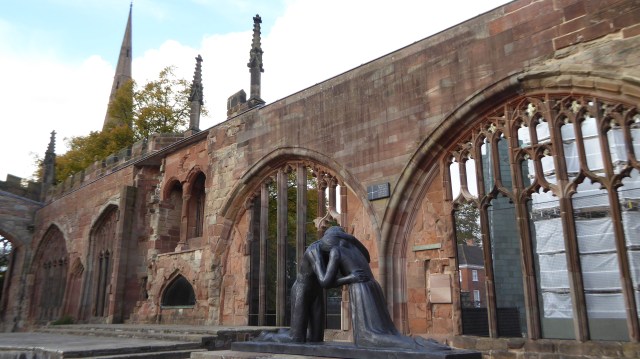
- Coventry lost not only its great medieval church of St Michael’s, the only English Cathedral to be destroyed in the Second World War, but its central library and market hall, hundreds of shops and public building and 16th century Palace Yard, where James II had once held court.
- The smell and heat of the burning city reached into the cockpits of the German bombers, 6,000 feet above.
- More than 43,000 homes, just over half the city’s housing stock, were damaged or destroyed in the raid.
- The fire at the city’s huge Daimler works was one of the biggest of the war in Britain. Up to 150 high explosive bombs and 3,000 incendiaries turned 15 acres of factory buildings into a raging inferno.
- At midday the next day in Coventry, it was as warm as spring and almost dark because of the effects of the firestorms.
- King George VI is said to have wept as he stood in the ruins of the burned out Cathedral, surveying the destruction.
- The people of the city were traumatised. Hundreds wandered to the streets in a daze and little children were seen trying to burrow their way through solid brick walls to escape the terrifying noise.
- One of the city’s three statues of Peeping Tom was blown out of a niche in its high building and lay in the street, where shocked passers-by mistook it for another human corpse in the blackout.
- One man recalled being pursued down a street by a knee-high river of boiling butter from a nearby blazing dairy.
- At one point during the night, an abandoned tram was blown clean over a house and into a garden. It landed with its windows still intact.
- The official death toll from the night was 554, but the real figure could have been much higher with many people unaccounted for.
- As help poured in the next day, demolition crews had to be prevented from pulling down the Cathedral tower. They didn’t realise it had been leaning for at least 100 years.
- On the day of the mass funerals, fighter patrols were sent up into the skies above the city. It was thought that the Germans might try to bomb the cemetery.
- Yet by 1947, Coventry had adopted its first German twin city, Kiel. Dresden followed in 1956. The ruined Cathedral now stands for international peace and reconciliation.
During the raids the Alvis car factory was severely damaged but the armaments factory was largely unscathed.
The Post below from the 70th Anniversary provides further information about the rebirth of Alvis cars after the War.
Seventy six years today, 14th November 1940, the Luftwaffe launched one of the largest aerial assaults of the second World War.
The attack was targeted at one of Britain’s major manufacturing cities, The City of Coventry. The Bombers were sent off in the afternoon and evening and headed to a cold and snowy Coventry.
The City was devasted by the bombings and included in the destruction was the Alvis Car Factory. The bombing was relentless for twelve hours. The Car Factory contained magnesium and this contributed to the fire that raged out of control.
Tragically some Alvis employees were killed in the raid and the Car Factory was gone.
In 1943 whilst fully involved with production for the War effort thoughts started to float around as to the Alvis role after the war. T.G. John’s strategic vision for the 1940s was very modern, to have a common chassis with interchangeable 2 and 3 litre engines. Finances and other constraints after the War ended resulted in the decision to offer a 2 litre car, loosely based upon an enlarged 12/70. In September 1944 The Board of Trade gave permission for work to start on the new car and so the TA 14 was born with the continued principle that bodies would be made by external Coachbuilders.
Following the ups and downs of developing the project the day finally arrived when the first 3 cars, Mulliners Saloons, emerged from the Alvis Factory.
The date, 14th November 1946, exactly 6 years to the day from the devastation of the Coventry blitz that destroyed the original Car Factory. The Post War car production was underway in Holyhead Road. The first 3 Cars were ready to be collected by their Dealers, 3 of the premier Agents fir Alvis car.
This iconic photo was posted on the 14th to show that Alvis were back in Car production.

From Brooklands of Bond Street, Mayfair, came Mr W.H.Bates to collect chassis 20573, Mulliners M1, to be JLP 344. From Galts of Glasgow came Keith Elliot to collect chassis 20589, Mulliners M3 to initially wear their number G1. From Hanna’s of Belfast came Mr W.J.Hanna to collect chassis 20655, Mulliners M5, to be registered GZ 6178. It is possible that the car in the background might be Mulliners M2, chassis 20553 exported to Switzerland on 15th January 1947.
The photo below shows those first 3 production cars to leave the Factory and come out into the rain. Stanley Horsefield, the Sales Manager is on the right of the photo.

For four years the TA/TB 14 would proudly be the standard bearer for the Alvis name in car production. It is a testimony to the quality of the cars produced that so many have survived
So now we have arrived at the 80th Anniversary of the first TA 14s leaving the factory. Eighty years as a tribute to Alvis quality, many of our cars are still going strong and even in 2026 ‘lost’ cars are still coming to light.
Fourteens the most successful car Alvis ever built.
P.S.
Jumping 80 years…..
[The one owner from new Mulliners Saloon, see below, is still available for sale by online Auction with Brightwells and now with no reserve, bidding finishes 9th December.
A Duncan to be restored is available on eBay until Monday, the owner is looking for
£3 500. Chassis no. 20773, NNU 20773.

